




Key Takeaways
- “Universal” means flexibility inside one adhesive system. You can use any etching technique, do direct and indirect procedures, and work with light-, dual-, or self-cured materials with no activator. It doesn’t mean every substrate or procedure gets treated the same way.
- Technique drives results. Scrub in two coats for 10 to 15 seconds each with no cure in between. Air-dry for at least 10 seconds until the surface is uniformly glossy, then light-cure separately for 10 seconds.
- Know where it fits. A dedicated zirconia primer and a dual-cure adhesive for posts still have their place. Whether you buy the bottle or unit doses depends on your volume and infection-control workflow, not cost alone.
Nathan Tarantelli walks through every one of these questions in our All-Bond Universal video. Watch the video →
“Universal” might be the hardest-working word in adhesive dentistry. It’s also one of the most misunderstood. It appears on a lot of labels, and a lot of people read it as a promise: one bottle, any procedure, no thinking required. That isn’t quite how it works. Universal adhesives aren’t all built the same way, and even a very good one still expects you to make good clinical decisions.
This article covers the questions BISCO’s sales team hears most often about All-Bond Universal. Nathan Tarantelli, BISCO Regional Sales Manager, answers each one in our video. All-Bond Universal launched in 2012 and draws on BISCO’s 45 years of adhesive research.
By the end, you’ll know what makes it universal and exactly how to apply it. You’ll also know where it fits, when a different product is the better tool, what it costs per use, and whether it belongs in your restorative workflow. We’ll be upfront about the tradeoffs too, because no adhesive is the right answer for every practice.
What Makes All-Bond Universal “Universal”?
All-Bond Universal is a light-cured adhesive for both direct and indirect restorations. It works with total-etch, self-etch, and selective-etch techniques. It’s also compatible with light-, dual-, and self-cured restorative materials, regardless of manufacturer, with no separate activator. Some universal adhesives need an extra bottle or activator once you move into indirect work. All-Bond Universal doesn’t.
Still, the length of the indications list isn’t really what makes it universal. What does is how much choice it gives you inside those procedures. You pick the etching approach that suits the tooth in front of you, not the one your adhesive insists on. You can bond a Class II composite in the morning and cement an indirect restoration in the afternoon without switching adhesive systems.
The real payoff is simplification. You stock fewer products, your whole team has fewer protocols to learn and keep straight, and there’s less room for mix-ups on a packed schedule. The simplified application is also designed to support a predictable protocol with minimal post-operative sensitivity.
“Universal” still has boundaries, though. It doesn’t mean every clinical situation should be treated exactly the same way. The substrate matters, the procedure matters, and proper surface treatment still matters. A universal adhesive doesn’t make your decisions for you. It gives you more options while you stay inside one adhesive system.
For more on what the label does and doesn’t promise, see Common Myths of a Universal Bonding Agent
How Do I Apply All-Bond Universal?
Here’s the direct restoration protocol from start to finish. Prepare the tooth using your preferred etching technique: self-etch, selective-etch, or total-etch. Then dispense one to two drops of All-Bond Universal into a clean mixing well and recap the bottle promptly, so the solvent doesn’t evaporate.
Next, apply two separate coats, scrubbing each one into the preparation with a microbrush for 10 to 15 seconds. The scrubbing isn’t busywork. The first coat interacts with the smear layer and partially dissolves it. The second coat promotes more thorough penetration and adaptation to the substrate. And here’s the detail people miss: don’t light-cure between coats.
Once both coats are on, air-dry thoroughly with the air syringe for at least 10 seconds. A quick puff won’t do it. You’re evaporating excess solvent, and you’re done when the adhesive has stopped moving and the whole preparation looks uniformly glossy. If it doesn’t, the Instructions for Use call for another coat, followed by the application and air-drying steps again.
Finally, light-cure All-Bond Universal for 10 seconds, then place your restorative material.
If you’ve had bonds fail unexpectedly with any universal adhesive, look at the air-drying step first. Residual solvents are a common culprit. We cover that and other technique traps in Why Does My Bond Keep Failing?
Can I Light-Cure All-Bond Universal at the Same Time as My Composite or Cement?
No. This is one of the questions our team hears most often, and BISCO strongly recommends following the Instructions for Use. Light-cure All-Bond Universal on its own before you move on to your composite or cement.
The same principle applies to cure time. Stick with the full 10 seconds, even if your curing light could probably illuminate a small stadium. A higher-output light doesn’t automatically mean the recommended curing time can be shortened. Adhesive dentistry rewards consistency, and following the protocol is how you get the performance the material was designed to deliver.
How Should I Dispense All-Bond Universal?
Dispense one to two drops into a clean well. You don’t need to shake the bottle first.
The bigger handling point is timing. All-Bond Universal contains solvents, and if the adhesive sits exposed in the well for a long time, those solvents can evaporate and affect the material before it ever reaches the tooth. The best workflow is to dispense when you’re actually ready to bond and go straight into the procedure. If your team usually dispenses at tray setup, change that habit for this step.
Why Would I Use All-Bond Universal Instead of Universal Primer?
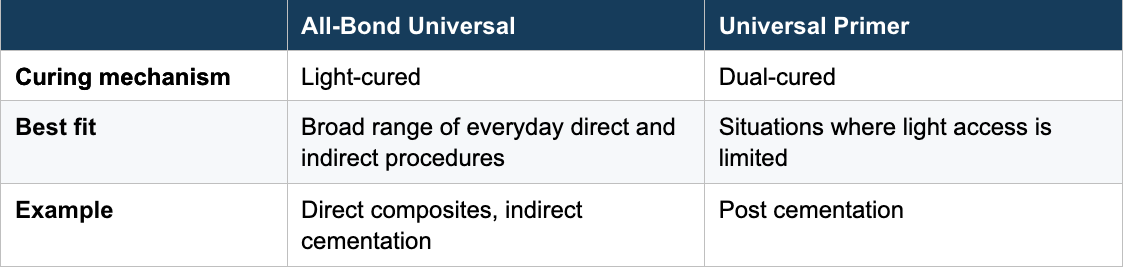
These two aren’t different versions of the same adhesive. They’re separate adhesive systems built around different curing mechanisms and procedural workflows. All-Bond Universal is light-cured. Universal Primer is a dual-cured adhesive system.
Dual-cure doesn’t automatically mean better. It means a different curing mechanism, and that mechanism has an advantage in certain situations. Post cementation is a classic example. Light doesn’t reach very far down a canal, so a dual-cure system like Universal Primer gives you a more appropriate workflow where light access is limited.
If you want a single-component, light-cured adhesive that covers a broad range of direct and indirect procedures, All-Bond Universal may fit your workflow better. The “best” adhesive depends on the procedure you’re doing and how you like to work.
Can All-Bond Universal Replace a Zirconia Primer?
All-Bond Universal contains MDP, the functional monomer commonly used to bond to zirconia. So it’s reasonable to ask whether you can skip the dedicated zirconia primer altogether.
Technically, yes, in a pinch. If you don’t have a dedicated MDP-containing primer on hand, All-Bond Universal can be used. But when you’re bonding to zirconia, BISCO recommends a dedicated zirconia primer such as Z-Prime Plus for optimal performance.
The reason is that having MDP doesn’t make every MDP-containing product equivalent. All-Bond Universal is designed to be versatile across a wide range of procedures and substrates. Z-Prime Plus is formulated specifically to prime zirconia, alumina, and metal surfaces. Think of it like a multitool: it has a screwdriver, and that screwdriver works, but you wouldn’t build a deck with it. When zirconia bonding is the job, use the product built for that job.
How Much Does All-Bond Universal Cost per Use?
All-Bond Universal comes in two delivery systems, a 6 mL bottle and unit doses, and their cost per use is noticeably different.

Prices are current as of publication. Check bisco.com for current pricing. If you order adhesives regularly, the BISCO Bonding Rewards program is also worth a look.
Should I Buy All-Bond Universal in a Bottle or Unit Doses?
If your only goal is the lowest possible material cost per application, the bottle will often win. But cost isn’t the only factor.
A bottle makes a lot of sense for practices that bond frequently and already have consistent dispensing and handling habits, like recapping promptly and dispensing only when ready. Unit doses offer a different kind of value. Each dose is single-use and convenient, and nobody handles the same bottle from one patient to the next. The acquisition cost is higher, but many practices find the convenience and workflow consistency worth it.
The answer here isn’t universal, which is a little ironic for this product. It depends on your practice volume, your infection-control workflow, how much adhesive you actually use, and how much you value convenience compared with cost per application.
What Are All-Bond Universal’s Limitations?
Like any product, All-Bond Universal has a few practical considerations. The first is the bottle design. It uses a twist cap, so the cap needs to go back on promptly after dispensing to minimize solvent evaporation. If your operatory has a reputation for leaving caps off, this is the product that will hold it against you.
The second is age. All-Bond Universal has been on the market since 2012, and newer universal adhesives have come out since. But newer doesn’t automatically mean better, and it doesn’t make All-Bond Universal outdated. It’s backed by 45 years of BISCO adhesive research and a substantial body of peer-reviewed evidence, and it has shown reliable performance over years of clinical use.
So, it may not be the newest adhesive on the market, but its long clinical history and research foundation are a big part of its value. If you’re weighing it against another popular adhesive, our All-Bond Universal vs. Scotchbond Universal Plus comparison breaks down the differences.
Who Is All-Bond Universal Best Suited For?
All-Bond Universal makes a lot of sense if you want one adhesive that covers a broad range of everyday restorative procedures. It also fits if you like the freedom to move between self-etch, selective-etch, and total-etch, you do both direct and indirect work, you want fewer adhesive systems to manage, or you want an adhesive backed by clinical data and science.
Another option may suit you better if you prefer a very procedure-specific adhesive system or a different application technique. The same goes if you routinely work in situations where a dual-cured adhesive has the advantage.
That’s really the point of this whole article. Don’t choose an adhesive just because the label says “universal.” Choose it because its chemistry, indications, handling, and workflow make sense for the dentistry you actually do. Before you decide, look at the procedures you perform most often, the etching techniques you prefer, the substrates you work with, and your cementation workflow.
Watch Nathan Tarantelli answer every one of these questions. Watch the video →
Still have questions? That’s exactly what we’re here for. Call to speak with a BISCO restorative expert, talk with your BISCO representative, or explore All-Bond Universal online.