


Key Takeaways
- Liners and base materials solve different clinical problems, and using the wrong one in the wrong situation can put an entire restoration at risk.
- Materials that release calcium and generate an alkaline pH help support pulp vitality, particularly in deep restorations and pulp capping cases.1-3
- Dual-cured base materials continue polymerizing even in areas the curing light can't fully reach, which self-cure or light-cure-only materials can't always guarantee.
- A calcium-releasing liner and a high-strength dual-cured base can be layered in the same preparation, giving deep restorations both biological protection and structural support.
Want to learn more about choosing the right base material for your restorations? Check out Episode 18 of BISCO Bites!
You're deep in a prep, close to the pulp, and now a decision has to be made fast: does this restoration need a liner, a base, or both? Get that call wrong, and the restoration can fail months later, either from a fractured foundation or a pulp that never fully recovered.
It's easy to get muddled when liner and base are treated as interchangeable terms for the same job, especially since they sit in the same part of the prep and get placed in the same appointment. BISCO's research into pulp biology and base mechanics has focused on separating those two questions, since a material built to support pulp vitality and one built to carry occlusal load are solving different problems with different chemistries.
This article breaks down what a liner does versus what a base does, when each is called for, and how the two can work together in the same preparation.
What's the Difference Between a Liner and a Base?
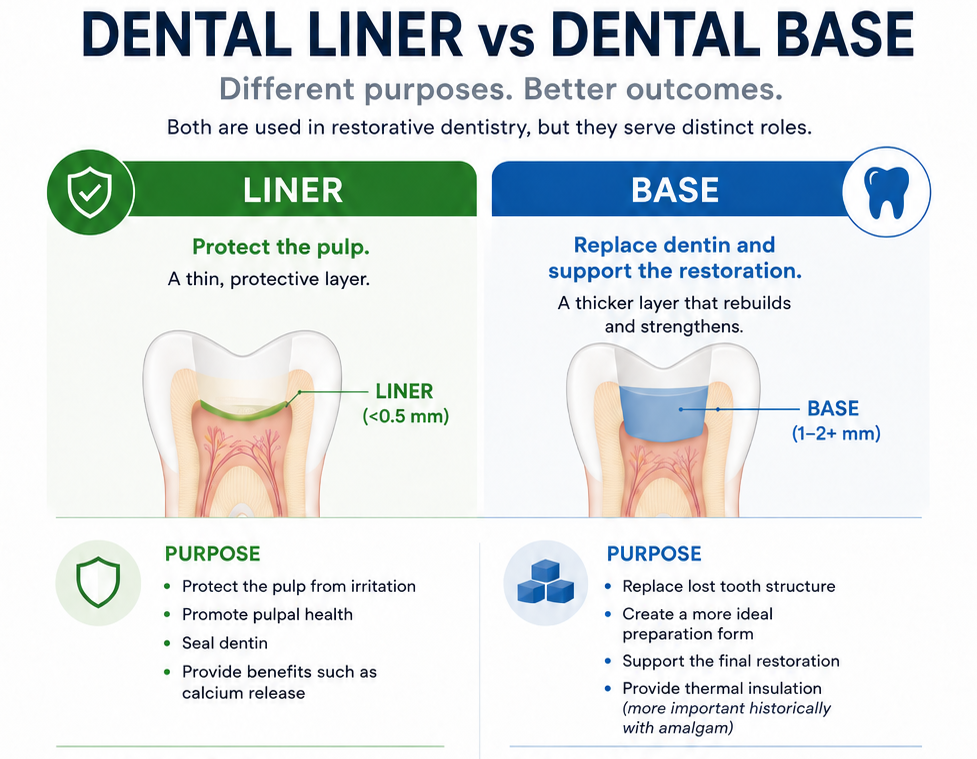
A liner and a base get placed in the same general area of preparation, but they're built to do different jobs. A liner is a thin layer applied at or near the pulp, and it’s main role is to provide added protection, support pulp vitality through calcium release and an alkaline pH that may provide the environment for the tooth to lay down reparative dentin.1-3 A base, by contrast, is a thicker layer that replaces missing dentin structure. Its job is mechanical: it needs to hold up under the flexural and compressive forces the tooth experiences every time the patient bites down.
Confusing the two often means asking one material to do a job it wasn't designed for, and that's usually where problems start.
When Does a Restoration Need Pulp Protection?
Pulp protection becomes a consideration any time caries removal brings a preparation close to or at the pulp, in both direct and indirect pulp capping scenarios. In these cases, an alkaline pH matters because it creates an environment that supports the pulp's own healing response,2,4 and calcium release supports the formation of reparative dentin over time.2,3 This is different from simply sealing a preparation. It's an active step meant to help pulp tissue recover from the trauma of decay and removal, not just isolate it from the restorative material going on top.
What Makes a Base Material Strong Enough to Hold Up?
Once pulp protection is addressed, the base must carry the mechanical load. Flexural strength determines how well a base resists bending and cracking under the flex a tooth undergoes during function, and compressive strength determines how well it withstands the direct force of occlusion. Traditional glass ionomers and resin-modified glass ionomers have long been used for this purpose, but they can fall short of newer dual-cured materials on both measures, especially in larger preparations where the base is doing more structural work.
Dual-cure chemistry adds another layer of reliability. A base that only sets with light cure risks incomplete polymerization in areas a curing light can't fully reach, like the bottom of a deep proximal box. A dual-cured base continues to set chemically in those shadowed areas, so the material isn't relying on light penetration alone to reach a full cure.
Can You Use a Liner and a Base in the Same Restoration?
In many deep restorations, the answer is yes, and it's often the better approach. A calcium-releasing liner placed first addresses the biological needs of the pulp, and a dual-cured base placed over it provides the mechanical strength the restoration needs to hold up long-term. This layered, sandwich-style approach lets each material do the job it was designed for instead of asking for a single product to cover both roles. BISCO's TheraCal LC and TheraBase are examples of materials built to work this way, with the liner addressing pulp vitality and the base providing the structural support layered on top.
What Should You Look for When Choosing a Foundation Material?
- A few questions can help clarify which material, or combination of materials, a given case calls for:
- Does the preparation need active support for pulp vitality, or is it deep but not close enough to the pulp to require it?
- Will the material fully cure in the depth of this preparation, or does the geometry of the box risk an incomplete cure with a light-only product?
- Does the base have the flexural and compressive strength to hold up under this patient's bite over years, not just months?
- And finally, is the material compatible with whatever composite or indirect restoration is going on top of it, so the whole system bonds and functions as one unit rather than a stack of mismatched layers?
The Foundation Decides the Outcome
A restoration is only as reliable as what's underneath it. Most failures traced back to the foundation aren't failures of the restorative material on top. They're failures of a liner or base that was skipped, undercured, or asked to do a job it wasn't built for. Taking the time to separate the biological question from the mechanical one, and choosing materials suited to each, is one of the more overlooked ways to protect a restoration's long-term success.
Want to learn more about choosing the right base material for your restorative procedures. Check out Episode 18 of BISCO Bites!
References
[1] ADA definitions for direct and indirect pulp capping at http://www.ada.org/en/publications/cdt/glossary-of-dental-clinical-and-administrative-terms
[2] Apatite-forming Ability of TheraCal Pulp-Capping Material, M.G. Gandolfi, F. Siboni, P. Taddei, E. Modena, and C. Prati. J Dent Res 90 (Spec Iss A): abstract number 2520, 2011.
[3] Okabe T, Sakamoto M, Takeuchi H, Matsushima K (2006) Effects of pH on mineralization ability of human dental pulp cells. Journal of Endodontics 32, 198–201.