



Key Takeaways
- Mechanical retention to enamel is non-negotiable. Phosphoric acid etching remains the standard, and skipping it is the most common cause of failed mechanical retention.
- Dentin is a different, more organic substrate, which is why etching it with phosphoric acid is a preference, not a requirement. Self-etch adhesives generate effective mechanical retention there too.
- Sandblasting can play a role in mechanical retention, but it isn't a bond strength shortcut. Internal BISCO testing found no measurable increase in bond strength when sandblasting was added to dentin before bonding.
This article draws from Episode 45 of Bonding & Beer, where Dr. Rolando Nuñez covers mechanical retention to the tooth structure in depth.
"Bonding" gets talked about like it's one thing: a single chemical event where adhesive meets tooth and sticks. In practice, most of what makes a bond strong and durable isn't chemical at all. It's mechanical, resin physically locking into a surface that's been prepared to receive it.
BISCO has built adhesive systems around that principle for decades, and it's a distinction that gets lost in day-to-day practice. When a bond fails, the instinct is to blame the material. Often, the real story is a missed step in creating the mechanical retention that bond depended on in the first place.
This article breaks down what mechanical retention actually is, why it's doing more work than most clinicians assume, how enamel and dentin behave differently as bonding substrates, and the techniques used to create it chairside, drawing on Dr. Rolando Nuñez's breakdown of the topic on Bonding & Beer.
What Mechanical Retention Really Is In Dentistry
At the microscopic level, a tooth surface prepared for bonding isn't smooth. Phosphoric acid affects enamel and dentin differently. On enamel, it roughens and demineralizes the surface, dissolving portions of the prism structure and opening up microporosities that resin can flow into and mechanically interlock with. On dentin, it demineralizes the surface and removes the mineral component, exposing the underlying collagen matrix. When low-viscosity resin infiltrates that exposed collagen network and polymerizes, it forms a hybrid layer along with resin tags extending into the dentinal tubules.
That interlocking structure is mechanical retention. It's not resin sticking to the tooth the way tape sticks to a wall, it's resin anchored inside the tooth surface. Some adhesive systems add a chemical bonding component on top of that, but the mechanical interlock is what actually holds the restoration in place over time.
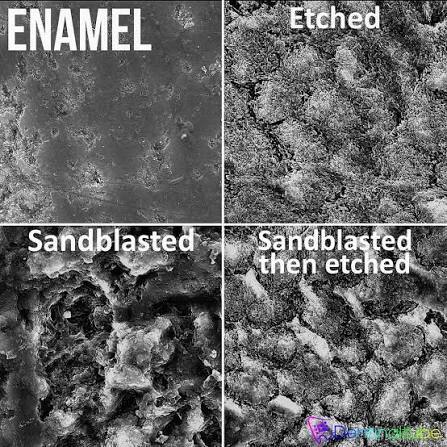
Photo courtesy of @dentinaltube on Instagram
Why Mechanical Retention Is Essential for Predictable Bonding
The reason this matters clinically comes down to sealing. A well-bonded enamel margin seals the restoration, and that seal is what keeps oral fluids and bacteria from working their way underneath it.
"Mechanical retention to the enamel is the most important, in my mind, because through a good bonding procedure to the enamel you are going to seal that restoration accordingly. And you want to seal the restoration because by sealing it you are going to mitigate — not eliminate, but mitigate, reduce — the possibility of leakage. That's something every dentist should work towards, because leakage will lead to secondary caries, and secondary caries is the number one reason for failure of composite restorations, and that is very well documented."
— Dr. Rolando Nuñez, Bonding & Beer, Episode 45
That's the throughline for everything else in this article. Mechanical retention isn't a technical curiosity, it's the mechanism behind the seal, and the seal is what determines whether a restoration survives long-term or comes back as a secondary caries case.
Enamel vs. Dentin as Bonding Substrates
Enamel is the more forgiving of the two substrates. It's roughly 90 to 95 percent inorganic, mostly densely packed hydroxyapatite, which behaves more like a ceramic than a living tissue. Phosphoric acid etching dissolves that mineral surface in a predictable, well-documented pattern, which is why enamel bonding has been reliable since Michael Buonocore first described acid-etch bonding to enamel in the 1950s.
Dentin is a different substrate altogether. It has a much higher organic content, including collagen, and is riddled with dentinal tubules that stay intrinsically moist. For years, dentin wasn't etched at all, out of concern that acid could harm the pulp. That changed when Professor Fusayama's research established that phosphoric acid could safely remove the smear layer and demineralize dentin, exposing the underlying collagen network. Professor Nakabayashi later described what happens next: resin infiltrating that exposed collagen and the opened dentinal tubules to form the hybrid layer, which is what actually generates mechanical retention on dentin.
The practical upshot is that enamel and dentin need to be treated as genuinely different substrates, not two versions of the same bonding problem.
Creating Proper Dental Mechanical Retention
There are three tools available for generating mechanical retention on tooth structure: phosphoric acid etching, sandblasting, and self-etch chemistry. All three can work on both substrates, but they don't perform the same way on enamel as they do on dentin.
Phosphoric Acid Etching
Phosphoric acid concentration has settled, over decades, into a range of roughly 32 to 37 percent, and there's no meaningful clinical difference between concentrations within that range. BISCO's Uni-Etch w/BAC, a 32 percent flowable formulation designed with total-etch technique in mind, and Select HV Etch w/BAC, a 35 percent thixotropic gel designed for selective-etch technique, are both suited to either approach in practice, the difference is really about viscosity and handling preference rather than a hard technique requirement.
Uni-Etch w/BAC and Select HV Etch w/BAC contain benzalkonium chloride (BAC), which has been shown in vitro to inhibit matrix metalloproteinases (MMPs), enzymes implicated in degradation of the dentin hybrid layer over time.¹ In vitro testing has also shown that BAC has antimicrobial activity against certain oral bacteria.2,3
NOTE: Inclusion of BAC has not been shown to correlate with a reduction in secondary decay in patients. In-vivo clinical studies to evaluate the effects of BAC on oral bacteria or caries have not been performed.
On enamel, phosphoric acid etching isn't optional. It's the standard against which every other method is measured, and it's the step most responsible for a durable marginal seal.
On dentin, phosphoric acid etching removes the smear layer, demineralizes the surface, and exposes the collagen and dentinal tubules that resin needs to infiltrate to form a hybrid layer. It's effective, but it's also a step where over-etching or letting the surface dry out at the wrong moment can cause the exposed collagen to collapse before resin can penetrate it, which could result in post-operative sensitivity.
Self-Etch Techniques
Self-etch adhesives combine etching and priming into a single step, using acidic monomers to demineralize and infiltrate the tooth surface at the same time rather than etching first and bonding separately. On enamel, self-etch systems can create some mechanical retention, but not to the same degree phosphoric acid does, which is the reasoning behind selective-etch protocols: etch enamel with phosphoric acid, then move to a self-etch adhesive for the rest of the prep.
On dentin, the calculation is different.
"Self-etch on dentin does not hinder bonding. When I test a self-etch adhesive as a product that generates mechanical retention and chemical interaction on dentin, compared to using phosphoric acid and the adhesive separately, we don't see any difference."
— Dr. Rolando Nuñez, Bonding & Beer, Episode 45
In other words, etching dentin with phosphoric acid is a preference, not a requirement. A self-etch adhesive on dentin can hold its own against a total-etch approach, with the added benefit of a lower chance of post-op sensitivity. Because self-etch adhesives make the smear layer permeable rather than removing it, the smear layer remains largely intact and continues to seal the dentinal tubules.
Sandblasting
Sandblasting uses a hard abrasive, typically aluminum oxide, delivered through a water-based sandblaster to mechanically roughen a surface rather than dissolving it chemically. On enamel, it's a viable way to generate mechanical retention, though it requires a meaningful equipment investment and doesn't offer an advantage over a syringe of phosphoric acid.
On dentin, the picture is more nuanced. BISCO tested 27-micron aluminum oxide sandblasting on dentin, using a Velopex AquaCare unit, in combination with All-Bond Universal, to see whether it improved bond strength.
"We did not see any increase in bonding. But one thing I feel is interesting about using a sandblaster to generate mechanical retention on dentin, prior to bonding, is the ability to clean the dentin without being as aggressive as if you use rotary instruments. You can be more conservative when you're removing decay and soft dentin."
— Dr. Rolando Nuñez, Bonding & Beer, Episode 45
So sandblasting dentin isn't a bond-strength lever on its own, at least based on this testing, but it can offer a more conservative way to manage caries removal and surface cleaning before bonding.
The Most Common Mistake in Mechanical Retention
"The most common mistake that leads to failed mechanical retention is not etching enamel with phosphoric acid. Phosphoric acid etching dentin is a preference, an option. Phosphoric acid etching enamel is not an option. It's a must."
— Dr. Rolando Nuñez, Bonding & Beer, Episode 45
It's a simple distinction, but an easy one to blur in daily practice, especially with self-etch and universal adhesive systems that make it tempting to treat every surface the same way. Enamel doesn't get that flexibility. Dentin does.
Conclusion
Mechanical retention isn't a footnote to the bonding process, it's the foundation of it. Enamel and dentin behave differently under an etchant because they're fundamentally different tissues, and treating them identically is where a lot of avoidable bond failures start.
The rule of thumb worth taking to chairside: phosphoric acid on enamel, always. On dentin, phosphoric acid, self-etch, or sandblasting all have a place, and the right choice comes down to what fits the case and the clinician's preference, not a fixed protocol.
Hear Dr. Nuñez walk through all of this in more depth on Episode 45 of Bonding & Beer.
References
- Tezvergil-Mutluay A, Mutluay MM, Gu LS, Zhang K, Agee KA, Carvalho RM, Manso A, Carrilho M, Tay FR, Breschi L, Suh BI, Pashley DH. The anti-MMP activity of benzalkonium chloride. J Dent. 2011 Jan;39(1):57-64. doi: 10.1016/j.jdent.2010.10.003. Epub 2010 Oct 14. PMID: 20951183; PMCID: PMC3866626.
- M.Sc.Dt. Emre ÖZEL, Dr. Haktan YURDAGÜVEN, Yrd.Doç.Dr. Esra CAN SAY, Prof.Dr. Sesin KOCAGÖZ, Evaluation of the Antibacterial Activity of Disinfectant Solutions with Phosphoric Acids Against Streptococcus Mutans. Journal of Hacettepe Faculty of Dentistry, Volume: 29, Issue 4, Page: 8-14, 2005
- M. TURKUN1, Z. ERGUCU, L.S. TURKUN, E.U. CELIK, and M. ATES, Is Phosphoric Acid Sufficiently Antibacterial?,J Dent Res 85 (Spec Iss B):abstract number 1605, 2006 (www.dental research.org).