


Key Takeaways
- Pairing compatible products, rather than adding more steps, is what actually reduces post-op sensitivity and restoration failure.
- All-Bond Universal with Select HV Etch and a selective-etch technique gives you a durable bond while limiting phosphoric acid contact with dentin.
- Core-Flo DC or Core-Flo DC Lite with Universal Primer delivers a reliable, fully chemical cure for deep preps, even when light access is limited.
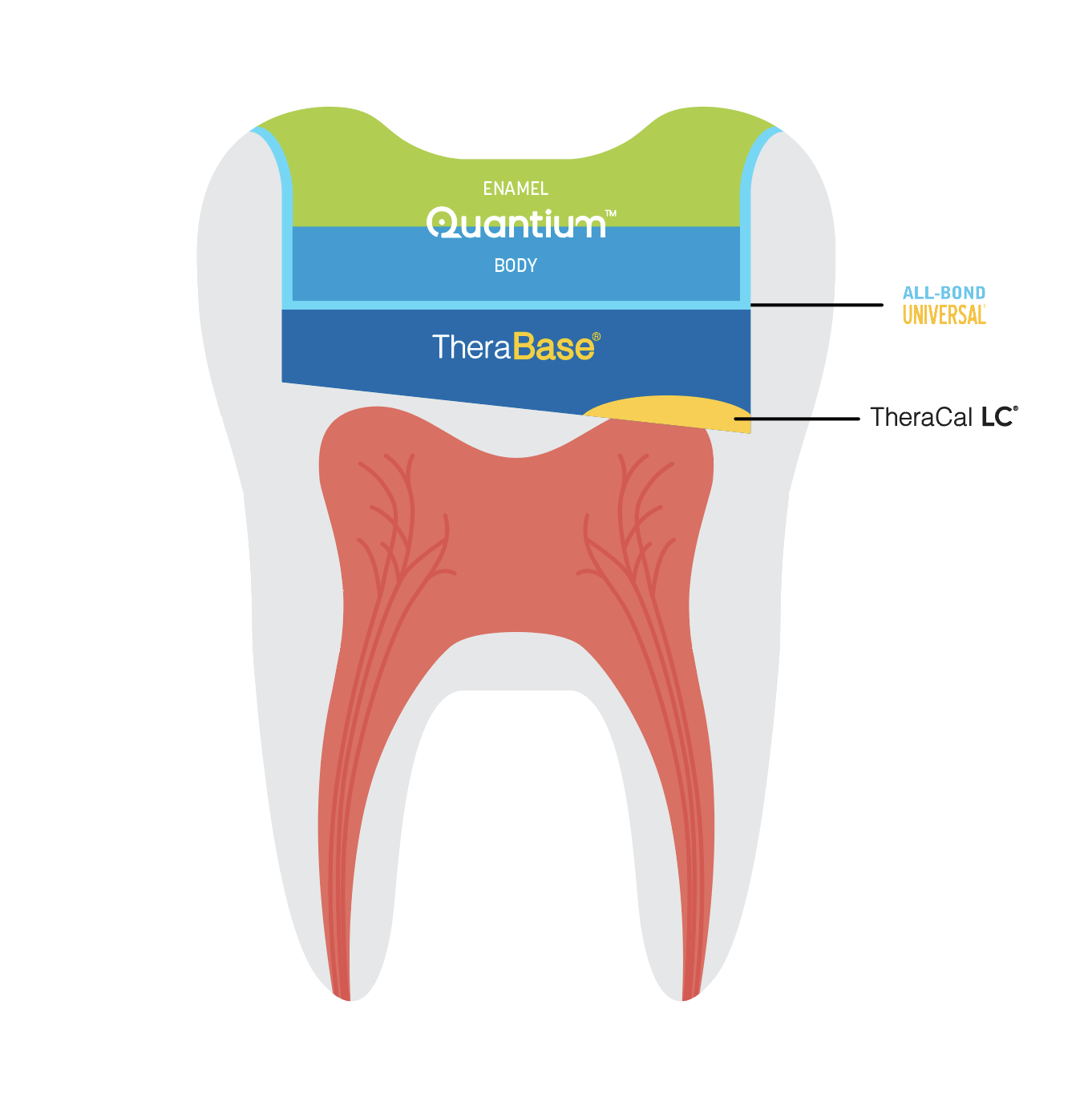
- TheraCal LC followed by TheraBase supports pulp vitality and tooth structure in the same visit you complete the restoration.1
Learn more about our product pairings by downloading our eBook, BISCO Perfect Pairs!
How many products are actually in your restorative workflow right now, and do you know for certain that all of them were designed to work together? Most dentists build their protocol over years, adding new products as technology advances and the industry changes. The result is often a stack of products that each work fine on their own but were never tested, formulated, or optimized to function as a system. When that happens, the extra steps you added to get better outcomes can just as easily be the reason a bond fails, a core buildup doesn't fully cure, or a patient calls back with post-op sensitivity.
BISCO's restorative materials are formulated with a deep understanding of adhesive dentistry, informed by decades focused specifically on that discipline. Etching, for instance, is a mechanical retention step, not a chemistry-matching one; any standard phosphoric acid etchant will work regardless of which bonding agent follows. Where that decades-long focus does show up is in curing mechanisms and material properties engineered to work well with clinicians' existing protocols and materials, whatever brand they're using.
This article walks through three BISCO product pairings that are built to work together, what problem each one solves, and why the combination outperforms using any one product in isolation. By the end, you'll be able to look at your own protocol and see where a compatible pairing could simplify a step, reduce a variable, or close a gap you didn't know was there.
Why Dental Product Compatibility Affects Restoration Success
Complexity in restorative dentistry isn't inherently a problem. But every additional product that wasn't designed with the others in mind is another place where something can go wrong. Materials that don't set on the expected timeline, adhesives that don't bond predictably to a base or liner, and cure chemistries that interfere with each other are common, quiet sources of restoration failure. They rarely get traced back to product incompatibility because the failure shows up later as sensitivity, marginal breakdown, or a redo, not as an obvious mistake during the procedure itself.
The fix isn't necessarily fewer products. It's making sure the products you use together were built to be used together. Below are three pairings where that intentional compatibility solves a specific clinical problem.
All-Bond Universal and Select HV Etch: Simple, Flexible Bonding
All-Bond Universal is a one-bottle adhesive compatible with any etching mode, which already makes it a flexible choice on its own. Paired with Select HV Etch w/BAC and a selective-etch technique, All-Bond Universal provides a simple way to apply BISCO’s recommended selective-etch protocol. Studies show that selective etching with a universal adhesive actually improves reliability of the bond.2,3
Select HV Etch is a 35% high-viscosity phosphoric acid etchant built for pinpoint placement. Because it stays exactly where you put it and washes off cleanly, you get full control over your bonding technique without the material running onto surfaces you didn't intend to etch.
That control is what makes the pairing effective at preventing post-op sensitivity. All-Bond Universal supports all etching techniques, including selective-etch, where only enamel is etched with phosphoric acid and dentin is left to the adhesive's self-etching primer. Select HV Etch's viscosity is what makes that selective application realistic to execute consistently, since it won't run past the enamel margin onto dentin. Together, the two products support a selective-etch technique: phosphoric acid is applied to enamel only, leaving the dentin smear layer intact. Because the smear layer isn't removed, there are no exposed dentinal tubules on dentin that need to be sealed, and no risk of the dentin drying out and the collagen collapsing, two of the more common causes of post-op sensitivity with total-etch technique.
For direct composites, indirect ceramics, and most everyday bonding procedures, this combination removes the guesswork. The selective-etch technique with these two products is the protocol BISCO recommends for the most predictable results.
TheraCal LC and TheraBase: Supporting Tooth Vitality in Deep Restorations
Deep preparations raise a second question beyond cure reliability: what are you doing to protect pulpal health at the same time you're building the restoration? Tooth vitality is easy to treat as a secondary concern once you've solved the structural side of a deep prep, but it's the reason the tooth stays functional and asymptomatic long term.
TheraCal LC is a calcium-releasing liner designed to encourage an alkaline pH and support pulp vitality when applied in the deepest areas of a preparation.*1 TheraBase is a dual-cured, calcium* and fluoride-releasing, self-adhesive base/liner that can be used on its own, or placed over TheraCal LC in cases involving pulpal exposure. Used together, the two products release more calcium than either would alone, extending that protective effect further through the tooth structure.*
Practically, this pairing doesn't add complexity to your procedure. You apply TheraCal LC in the deepest area of the prep, cover it with TheraBase, and move forward with bonding, composite placement, and finishing exactly as you normally would. You end up with an aesthetic, functional restoration built on a foundation that's actively supporting the health of the tooth underneath it, not just its structural integrity.
Core-Flo DC or Core-Flo DC Lite and Universal Primer: A Reliable Cure for Deep Preps
Deep preparations create a specific problem: you need a core buildup material you can trust to cure fully, regardless of how deep the prep is, how thick the layers are, or how consistent your light-curing equipment happens to be at that depth. A material that only partially cures at the base of a deep prep isn't a minor issue. It's a structural risk for the entire restoration.
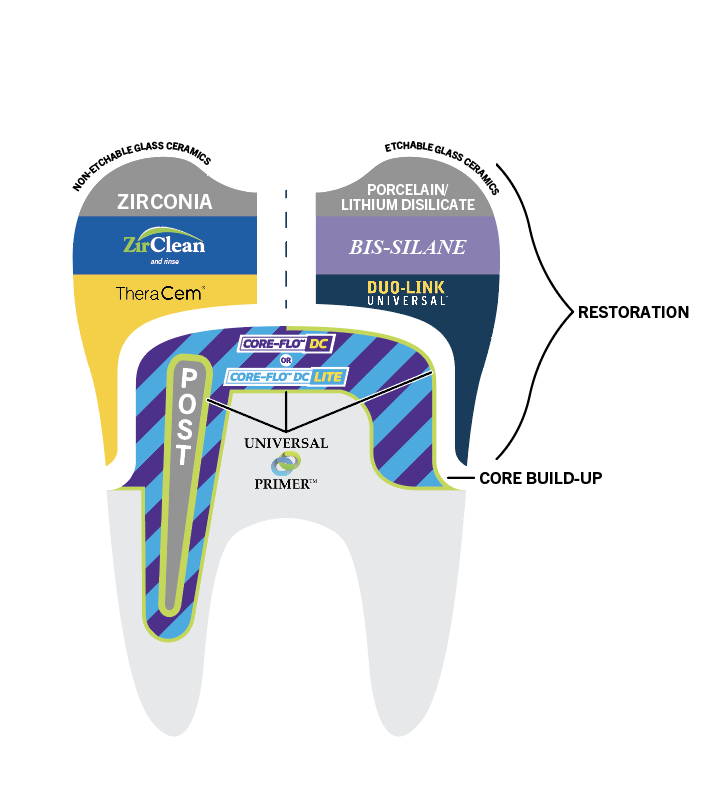
Core-Flo DC and Core-Flo DC Lite are dual-cured, radiopaque core buildup composites built to cement posts and build core structure in a single application. Core-Flo DC is formulated to be more stackable, while Core-Flo DC Lite is formulated to be more flowable, so you can choose based on the case.
Paired with Universal Primer, a two-bottle, dual-cure adhesive, Core-Flo DC/Core-Flo DC Lite has a bonding partner that matches its cure profile. Both products are dual-cured, meaning each is capable of a full chemical cure on its own, without a curing light, in addition to light-curing when access allows. That matters most in deep preps, post space, or under crowns, where light access is limited or absent: the bond and the core material both reach a full cure chemically, so the restoration isn't left depending on light that may never reach the base of the prep. It also works with any etching technique, so it doesn't force a change to the rest of your protocol.
Choosing Compatible Dental Products for Predictable Outcomes
Every one of these three pairings solves the same underlying problem in a different part of the procedure: reducing the number of places where an untested combination of materials can quietly undermine an otherwise good restoration. Post-op sensitivity, incomplete cures, and restorations that fail despite a solid rebuild often trace back to the same root cause: materials or techniques that weren't well-matched to the situation. Choosing materials with a proven track record for compatibility and technique tolerance, and following manufacturer protocol closely, goes a long way toward avoiding these outcomes.
Every product in this lineup is formulated to work reliably alongside the materials dentists already use, regardless of manufacturer, not just other BISCO products. If you're already comfortable with a particular adhesive, cement, or liner, the goal is compatibility with what's in your operatory, not a wholesale switch to a BISCO system.
Learn more about our product pairings by downloading our eBook, BISCO Perfect Pairs!
*BISCO has data on file
1. T. Okabe, M. Sakamoto, H. Takeuchi, K. Matsushima. Effects of pH on Mineralization Ability of Human Dental Pulp Cells. Journal of Endodontics. Volume 32, Number 3, March 2006
2. De Goes Mario Fernando, et al. Performance of a new one-step multi-mode adhesive on etched vs non-etched enamel on bond strength and interfacial morphology. The journal of adhesive dentistry. 16 3 (2014); 243-50.
3. Takamizawa T, Barkmeier WW, Tsujimoto A, et al. Influence of pre-etching times on fatigue strength of self-etch adhesives to enamel. J Ahes Dent. 2016; 18:501-511.