




Modern Composite Esthetics Without Compromise
In dentistry today, esthetics aren’t optional—they’re expected.
Patients are more visually aware than ever. They notice shade mismatches, flat anatomy, and restorations that don’t quite blend with surrounding tooth structure. Even when a restoration is technically sound, esthetic shortcomings can undermine patient confidence and satisfaction.
For clinicians, that creates real pressure. Strength, durability, and wear resistance will always matter—but when shade matching, translucency, or polishability fall short, the restoration can still feel like a miss. In many cases, esthetics are what patients judge first, and what they remember longest.
That’s why modern restorative materials can’t focus on performance alone. They need to deliver natural-looking esthetics without adding complexity, unpredictability, or unnecessary chair time.
How Can I Achieve Consistent Esthetics in Restorative Dentistry?
Most composites today can look good under the right conditions. The challenge is consistency.
Some materials offer strong chameleon effects that blend efficiently in simple cases but limit control in more demanding anterior work. Others rely on full shade systems that provide customization—but require additional layering steps, shade decisions, and technique sensitivity.
There’s no universal “best” approach. The right solution depends on the case, your workflow, and how much control you want over the final result. What matters most is predictability—knowing how a material will look after curing, polishing, and under different lighting conditions.
Finding the Right Esthetic Approach for Your Practice
Clinicians typically fall into one of a few camps when it comes to esthetics:
- Those who prefer simplified blending for efficient, everyday restorations
- Those who want full control through layering and characterization
- And many who move between both approaches depending on the clinical situation
There’s no one-size-fits-all answer. The best esthetic system is the one that consistently delivers results in your hands, whether you’re restoring a small Class III or managing a highly visible anterior case.
How Can Quantium Help Achieve More Consistent Esthetics?
Quantium was developed with this balance in mind—aiming to support natural esthetics without forcing clinicians into a single technique or workflow.
It follows the VITA® shade system, the most widely used shade guide in dentistry, to support predictable shade selection and communication. Quantium is available in A1, A2, A3, A3.5, B1, and B2, along with two effect shades—Bleach and Incisal—for cases that require added brightness or translucency.
The system is built around two complementary shade categories:
- Body shades with higher opacity to support dentin-like depth and masking
- Enamel shades with increased translucency to better mimic natural enamel and light transmission
Used together, these options allow clinicians to create restorations that reflect light more naturally and blend seamlessly with surrounding tooth structure—especially in cases where value, brightness, and translucency matter most.
That said, clinicians who exclusively rely on single-shade, high-chameleon materials for speed may prefer simpler systems for routine cases. Quantium is best suited for those who want flexibility—efficient when needed, more customizable when the case demands it. 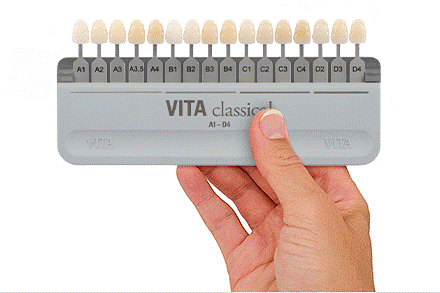
Photo courtesy of VITA
A Reality Check on Shade Matching Your Restoration
Even when composites follow the same shade guide, they don’t behave identically.
Differences in opacity, translucency, and filler composition can affect how a shade looks after curing and polishing. That’s why two A2 composites from different manufacturers may appear noticeably different chairside.
To improve predictability—especially in high-esthetic cases—it helps to:
- Create custom shade tabs using the composite you place most often, or
- Use the manufacturer’s shade guide when available
It’s a small step, but one that can significantly reduce surprises and remakes.
Esthetics as a Bridge to Trust
In modern dentistry, esthetics aren’t about vanity. They are about trust. Patients expect restorations that blend so seamlessly they effectively "disappear." When a restoration looks right, the patient doesn’t question the clinical work. That visual success leads to higher satisfaction, greater confidence in your future recommendations, and fewer post-op remakes.
For the practice, the award-winning esthetics of a material like Quantium deliver a predictable ROI that goes well beyond appearance. By achieving a natural match without complex layering or unpredictable outcomes, you reduce chair time and eliminate the stress of a "missed" shade. Ultimately, the best clinical outcome is a restoration the patient never has to think about, along with a workflow that lets you move confidently to the next case.
Ask yourself: Is your current composite making esthetics harder than they need to be? If you’re still struggling with "graying out" or complex shade matching, it might be time to see why the simplicity of Quantium offers a better path forward.