


Key Takeaways:
- One of the most important distinctions between these materials is their indication for pulp capping. TheraCal LC is FDA-cleared as a pulp capping agent, while Lime-Lite Enhanced is indicated as a base and liner and is not indicated for direct placement on exposed pulp. If pulp exposure is possible, TheraCal LC is the appropriate choice.
- Calcium silicate chemistry contributes to different material properties that may be relevant depending on the clinical objective. TheraCal LC releases more calcium¹* and generates an alkaline pH²˒³* — both associated with apatite formation²˒⁴ and pulp vitality²˒³. Lime-Lite Enhanced does not generate an alkaline pH.*
- Similar packaging, different science. Both look alike on the table, but TheraCal LC accounts for direct pulp capping, while Lime-Lite Enhanced does not.
In deep preparations where pulp exposure is possible, material selection becomes clinically significant. Choosing a material that isn’t suited for the case can lead to post-op sensitivity, compromised pulp vitality, or worse, a restoration that fails before it should. Choosing the proper tools for your restoration results in a tooth that's protected and built to last.
BISCO brings over 45 years of experience in adhesive dentistry and dental material science, which informed the development of TheraCal LC. When BISCO's TheraCal LC and Pulpdent's Lime-Lite Enhanced come up in the same conversation, you understand why. On the surface, they look nearly identical: light-cured, calcium-releasing, syringe-delivered, sitting side by side on your bracket table. But dig into the science, and the differences are significant.
By the end of this article, you'll have a straight answer, grounded in clinical evidence, not marketing, so your patient walks out with a tooth that's protected, healing, and built to last.
Why the Liner You Choose Matters More Than You Think
A liner isn't just a placeholder between your prep and your composite. It's an active participant in the outcome of that tooth. The right liner creates an environment that protects the pulp, stimulates healing, and supports the long-term success of the restoration on top of it. The wrong one can dissolve over time, fail to generate the response, or simply not perform when the clinical situation demands it most.
A Quick Look at Both Products
What Is TheraCal LC?
TheraCal LC is a light-cured, resin-modified calcium silicate liner and pulp capping agent developed by BISCO. It's indicated for both direct and indirect pulp capping and as a protective liner under composites, amalgams, cements, and other base materials. Its proprietary formulation consists of tri-calcium silicate particles in a hydrophilic monomer, that provides significant calcium release1*, which generates an alkaline pH and stimulates hydroxyapatite and secondary dentin bridge formation 2-4.
What Is Lime-Lite Enhanced?
Lime-Lite Enhanced by Pulpdent is a light-cured cavity liner formulated for use with adhesives, composites, and conventional restorative materials. It releases calcium, phosphate, and fluoride ions, is moisture tolerant, radiopaque, and notably does not contain BPA, Bis-GMA, or BPA derivatives. Its base chemistry is urethane dimethacrylate — think composite-like rather than calcium silicate. It's a solid product with a legitimate following in the dental community.
Now let's talk about where they diverge.
How Do They Compare? The Key Differences Broken Down
Chemistry: The Engine Under the Hood
The underlying material chemistry highlights key differences. TheraCal LC is built on true calcium silicate chemistry — the same foundational chemistry as MTA, which has decades of clinical evidence behind it for pulp healing. According to BISCO’s Associate Product Manager Luke Martinovich, creating an environment that supports apatite formation.4 Remineralization is a well-established biological process, and calcium availability at the material-tooth interface plays an important role in supporting this environment, TheraCal LC is formulated to release calcium*1, which helps create conditions favorable for secondary bridge formation at the site of placement. 2,4
Lime-Lite Enhanced uses a urethane dimethacrylate-based chemistry, while TheraCal LC is formulated with calcium silicate technology commonly associated with bioactive pulp capping materials. Lime-Lite Enhanced does release calcium, but research has shown it releases significantly less than TheraCal LC, and has an acidic pH, so it is not indicated for direct pulp capping applications. That alkaline pH isn't just a nice-to-have. It's the trigger that drives pulpal healing, pulp vitality, and apatite formation.2,3
Pulp Capping Capability — Can You Use It Directly on the Pulp?
This is likely the most clinically important distinction between the two materials. TheraCal LC is indicated for both direct and indirect pulp capping. Lime-Lite Enhanced is not indicated for direct pulp capping.
That means if you have a pulp exposure, carious or mechanical, TheraCal LC can go directly on it. Lime-Lite Enhanced cannot. As Martinovich puts it, "Lime-Lite can only be used for indirect pulp capping and lining. Direct application can have a detrimental effect on the pulp."3, 5
This alone should drive your decision-making framework for any case where exposure is possible.
Ion Release Profile — What's Actually Coming Out of These Materials?
TheraCal LC releases calcium ions and generates an alkaline pH of 10-11.1,3 An alkaline pH is critical because it's what creates the hostile-to-bacteria, friendly-to-healing environment the exposed pulp needs.5,6 Lime-Lite Enhanced releases calcium, phosphate, and fluoride.
The fluoride release from Lime-Lite is worth acknowledging; it's real, and fluoride has genuine caries-prevention value. But when it comes to promoting pulp vitality specifically, calcium silicate-driven dentin bridge formation is the priority, and TheraCal LC may provide advantages in this area based on the published research. Fluoride releasing materials should not be placed directly on a pulpal exposure, as it could negatively affect the pulp.7
Solubility and Long-Term Stability
TheraCal LC has low water solubility and will not wash out over time. Lime-Lite Enhanced is also virtually insoluble in water and oral fluids. Neither product will dissolve mid-restoration. This is a shared strength, not a differentiator.
Ease of Placement and Clinical Workflow
Both products come in a syringe delivery system, which makes precision placement in deep or tight preps practical. TheraCal LC light-cures in 20 seconds. One important placement note that Martinovich flags as a common mistake: "Apply TheraCal LC on visibly moist dentin, and do not use a bonding agent prior to application." A bonding agent before TheraCal LC will actually inhibit its calcium release. Follow the protocol, and the material performs exactly as designed. Lime-Lite Enhanced, by contrast, recommends an adhesive for increased adhesion values. As stated previously, this will hinder your ion release whether that’s calcium, phosphates, or fluoride.*
Compatibility With Restorative Materials
Both products are compatible with composites, adhesives, and conventional restorative materials. No differentiator here.
The Research Behind TheraCal LC — 15 Years of Science
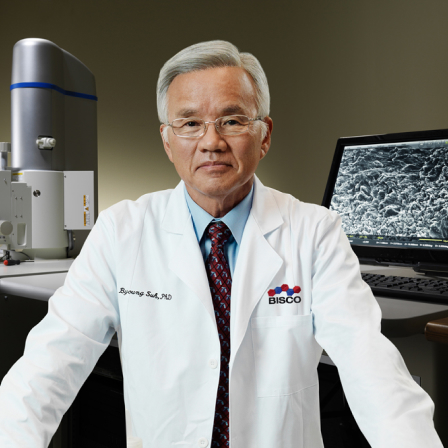
TheraCal LC was over a decade in development before its launch, and it has been validated by peer-reviewed research, independent clinical evaluations, and real-world use across dental practices in more than 90 countries. BISCO's founder, Dr. Byoung Suh, has authored or co-authored over 150 published articles and abstracts on adhesion and bonding. The science behind TheraCal LC isn't a marketing claim. It's documented, cited, and reproducible. Full peer-reviewed references are available.
Martinovich also notes something that 15 years of real-world use has taught BISCO that early studies couldn't fully capture: "TheraCal LC was designed to provide both short-term and long-term performance. You want immediate response and long-term clinical performance, and that's exactly what TheraCal LC was built to deliver."
That said, Lime-Lite Enhanced may still be a reasonable option for clinicians focused primarily on indirect pulp capping or cavity lining in lower-risk restorative cases, particularly when fluoride release or BPA-free formulation is a higher priority within their workflow. The key distinction is understanding where each material is indicated and what clinical outcomes the clinician is prioritizing.
So, Which One Should You Choose?
Clinically, the distinction is as follows:
For cases involving direct pulp exposure, TheraCal LC is the more appropriate option based on its direct pulp capping indication and calcium silicate chemistry. Lime-Lite Enhanced is not indicated for direct pulp capping. This distinction is clinically significant.
For indirect pulp capping and deep prep lining, TheraCal LC remains the stronger option based on its superior calcium ion release, alkaline pH generation, and the depth of clinical evidence behind its calcium silicate chemistry. Lime-Lite Enhanced is not without merit. The fluoride release is real, the BPA-free formulation appeals to some clinicians, and if someone is already comfortable with it for indirect cases, it performs adequately. For clinicians prioritizing calcium silicate chemistry and direct pulp capping capability, TheraCal LC may offer advantages based on the available published research.
As Martinovich puts it when clinicians say they've been using Lime-Lite and their patients are fine: "While the products may appear similar clinically, their underlying chemistry and indications differ in meaningful ways. There are things going on that the clinician can’t see with the naked eye."
Your clinical decision framework:
Deep prep with pulp exposure → TheraCal LC
Deep prep, no exposure, indirect cap → TheraCal LC for apatite formation; Lime-Lite Enhanced is an option if fluoride release is a priority2,4
Protective liner under composite or amalgam → TheraCal LC or Lime-Lite Enhanced
Want to Learn More About TheraCal LC?
When clinicians choose a liner for deep preparations or pulp exposures, they need confidence that the material is supported by both clinical research and real-world performance. TheraCal LC was developed to support pulp vitality and long-term restorative success – with more than 15 years of clinical use and research behind it.
To learn more about TheraCal LC, clinical protocols, or published research, visit bisco.com/theracal-lc or contact BISCO’s clinical support team at 1-800-247-3368.
Concerned about post-op sensitivity in your deep preps? Read our related article: 3 Tips to Avoid Post-Op Sensitivity
Frequently Asked Questions
Can TheraCal LC be used for direct pulp capping?
Yes. TheraCal LC is FDA-cleared as a pulp capping agent and is backed by published clinical data. Apply directly to the pulp exposure on visibly moist dentin and light-cure for 20 seconds.
Does TheraCal LC contain Bis-GMA?
Yes. Refer to the Safety Data Sheet available at bisco.com/education/sds for more details.
How long do I light-cure TheraCal LC?
Light-cure for 20 seconds. Apply in a layer less than 1mm thick on visibly moist dentin. Do not apply a bonding agent prior to placement. This will hinder calcium release.
Is TheraCal LC compatible with all bonding agents?
TheraCal LC is fully compatible with bonding agents, adhesives, and restorative materials placed over it, including composites, amalgams, and cements. However, it should be applied directly to dentin without a bonding agent underneath, as placing an adhesive prior to TheraCal LC can interfere with its calcium release and intended performance.
What's the difference between TheraCal LC and calcium hydroxide?
Calcium hydroxide-based materials have well-documented high solubility. They dissolve over time, which compromises the long-term seal. 8,9 TheraCal LC has low water solubility, will not wash out, and delivers superior calcium release.*1 For a full breakdown, see BISCO's original article on this topic at bisco.com.
Can I use TheraCal LC and my composite in the same visit?
Yes. Because TheraCal LC is light-cured, it sets immediately and the restoration can be placed in the same appointment.
* BISCO has data on file
1. Gandolfi MG, Siboni F, Prati C. Chemical–physical properties of TheraCal, a novel light-curable MTA-like material for pulp capping . International Endodontic Journal. 2012 Jun;45(6):571-9
2.ADA definitions for direct and indirect pulp capping at http://www.ada.org/en/publications/cdt/glossary-of-dental-clinical-and-administrative-ter
3. Okabe T, Sakamoto M, Takeuchi H, Matsushima K (2006) Effects of pH on mineralization ability of human dental pulp cells. Journal of Endodontics 32, 198–201.
4. Apatite-forming Ability of TheraCal Pulp-Capping Material, M.G. GANDOLFI, F. SIBONI, P. TADDEI, E. MODENA, and C. PRATI J Dent Res 90 (Spec Iss A):abstract number 2520, 2011 (www.dentalresearch.org)
5. Hirose Y, Yamaguchi M, Kawabata S, et al. Effects of Extracellular pH on Dental Pulp Cells In Vitro. Journal of Endodontics. 2016 May;42(5):735-741. DOI: 10.1016/j.joen.2016.01.019. PMID: 26951958
6. Kim, Ryan Jin-Young, et al. “An in vitro evaluation of the antibacterial properties of three mineral trioxide aggregate (MTA) against five oral bacteria.” Archives of oral biology 60.10 (2015): 1497-1502.
7. Kranjevac T, Milovanovic M, Volarevic V, Lukic ML, Arsenijevic N, Markovic D, et al. Cytotoxic effects of glass ionomer cements on human dental pulp stem cells correlate with fluoride release. Med Chem. 2012;8(1):40–45
8. Arandi NZ. Calcium hydroxide liners: a literature review. Clin Cosmet Investig Dent. 2017;9:67-72
9. Francisconi LF, de Freitas AP, Scaffa PMC, Mondelli RFL, Francisconi PAS. Water sorption and solubility of different calcium hydroxide cements. J Appl Oral Sci. 17(5):427–431.