


Key Takeaways
- The universal adhesive market is crowded and most products claim the same things. The real differences come down to water content, pH, bond strength data, and whether you actually need an activator for indirect cases.
- Chemistry details matter clinically. Higher water content accelerates bond degradation over time, and silane built into a universal adhesive sounds convenient — but published research shows it becomes unstable in the low-pH environment where universal adhesives operate.1,2,3,4
- Price per bottle is only part of the cost equation. Factor in activators and long-term reliability, including the cost of remakes, before deciding what's actually cheaper.
Choosing a dental adhesive should be straightforward. It should bond reliably, work across your case mix, and perform the same way every time — without adding steps. The problem is that every universal adhesive on the market claims to do exactly that. So when the marketing language is virtually identical across five products, how do you actually choose?
At BISCO, we've spent 45 years in adhesive chemistry. It's not a product category for us, it's our foundation. We’ve developed and tested generations of adhesive systems to understand how each component impacts real-world bond performance.
Here's an honest, side-by-side breakdown of the five most widely used universal dental bonding agents on the market. What each one does well, where the tradeoffs are, and which clinical situations each one is best suited for.
Most universal adhesives fall into two categories: those optimized for convenience and those engineered for long-term chemical stability. The differences aren’t always obvious in product literature, but they show up clearly in the data.
One thing worth noting upfront: All-Bond Universal is a BISCO product, and this article is written by BISCO. We've included it in this comparison because we think honest, side-by-side evaluation is more useful to you than a one-sided product page.
What Actually Matters When Comparing Dental Bonding Agents
Before the product comparisons, it's worth establishing the variables that meaningfully differentiate universal adhesives, because "strong bond" and "versatile" appear in every brochure and don't help you make a decision.
Bond Strength to Dentin
Raw bond strength numbers matter, but context matters more. Look for data across all etch modes — self-, selective-, and total-etch — and across cure modes. An adhesive that performs well in one mode but not another is a liability in a mixed-case practice.
Water Content
This is one of the most underappreciated variables in adhesive chemistry. Water is the hardest solvent to remove during application. Unlike acetone or ethanol, it doesn't evaporate cleanly or quickly. Residual water left after air drying increases permeability in the cured adhesive. Over time, that accelerates hydrolytic degradation. It can also lower the adhesive’s pH, shortening shelf life and increasing the risk of post-operative sensitivity. Lower water content means more forgiving application and longer-lasting bonds.2
pH
A universal adhesive's pH affects two things that matter clinically: compatibility with self-cured and dual-cured materials, and the stability of any silane incorporated into the formula. More on the silane issue below.1,3,4
Activator Requirement
Some adhesives require a separate activator when used with self-cured or dual-cured cements from other manufacturers. That's an additional SKU, an additional cost, and an additional step that introduces variability. True single-bottle universality means no activator.
Silane: Convenience or Compromise?
Several universal adhesives incorporate silane directly into the bottle, allowing them to claim compatibility with glass ceramic restorations without a separate primer. It sounds convenient. Published research suggests otherwise. Silane becomes unstable in low-pH environments through self-condensation and dehydration reactions — and universal adhesives are, by definition, low-pH. Two independent studies have demonstrated that this instability leads to measurably decreased bond strength to glass ceramics over time1,3,4. The takeaway: a separate ceramic primer backed by stable chemistry is a more reliable approach than a built-in silane that may degrade under clinical conditions.
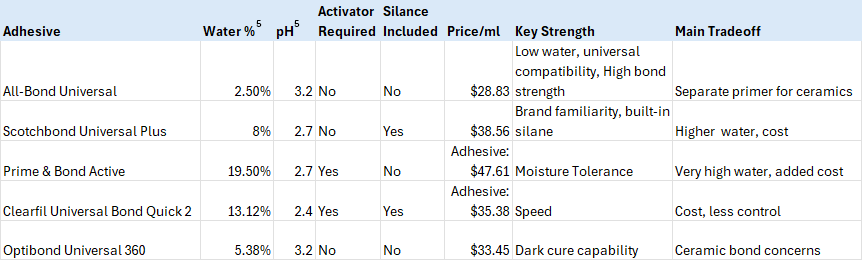
Prices are based on Pearson Dental pricing and may vary depending on the distributor.
Top 5 Universal Dental Bonding Agents Compared
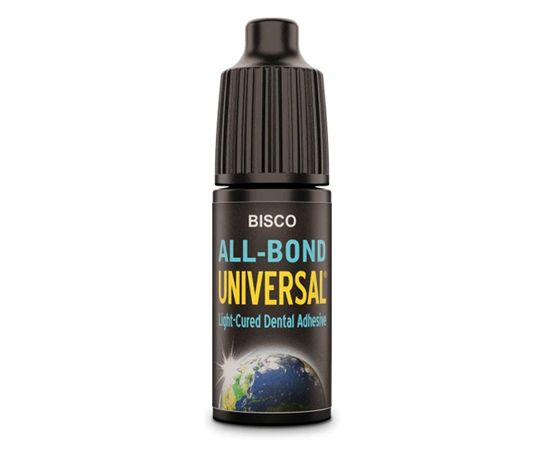
1. BISCO All-Bond Universal
Best for: Clinicians who want maximum versatility, strong dentin bond strength, and no compatibility surprises.
All-Bond Universal is a single-bottle, light-cured universal adhesive with a pH of 3.2 and a water content of 2.5%5— the lowest of any adhesive in this comparison.
With MDP monomer chemistry and a unique hydrophilic-to-hydrophobic transition after curing, All-Bond Universal wets the tooth surface effectively at placement, then becomes hydrophobic after curing for a less permeable, more durable seal. No activator is required with any light-, self-, or dual-cured material from any manufacturer, making it a genuinely open system. A 6ml bottle yields approximately 145 restorations at $28.83/ml, the lowest price per ml in this group.
Tradeoff: All-Bond Universal does not contain silane, so a separate primer is recommended for glass ceramic restorations,
Clinical verdict: Lowest water content and price per ml in the group, no activator required, and strong dentin bond strength across all etch and cure modes — a reliable single-bottle solution for direct and indirect cases alike.
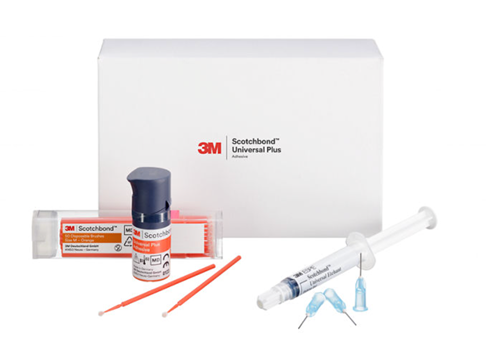
2. Solventum Scotchbond Universal Plus
Best for: Clinicians who prioritize brand familiarity and want silane built in for glass ceramic cases.
Scotchbond Universal Plus is the most recognized name in universal adhesives, supporting all three etch modes with a long clinical track record and strong brand infrastructure behind it.
With a pH of 2.7 and a water content of 8%, Scotchbond Universal Plus sits among the higher values in this comparison.*5 That higher water content makes complete evaporation of residual water more difficult, increasing the potential for hydrolytic degradation over time.2 It also incorporates silane for glass ceramic bonding without a separate primer — convenient on the surface, but published research raises questions about silane stability in low-pH environments.1,3,4 Pricing comes in at $38.56/ml, higher per ml than several others in this group.
Tradeoff: Higher water content and per-ml cost are the two most meaningful variables, and the silane stability research warrants attention for practices with significant ceramic volume.
Clinical verdict: A well-supported product with strong market presence — clinicians already using it comfortably may not have a compelling reason to switch, but practices evaluating from scratch should weigh the water content and cost carefully.
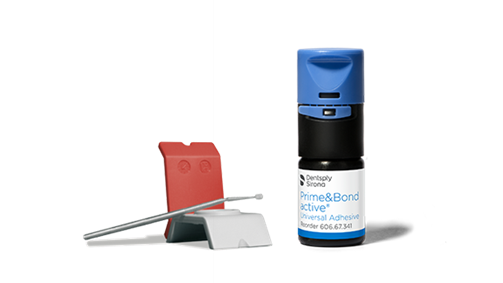
3. Dentsply Sirona Prime & Bond Active
Best for: Clinicians who prioritize moisture tolerance in challenging isolation conditions.
Prime & Bond Active is designed around simplicity and moisture tolerance, formulated to bond to dentin across a wide range of moisture levels for more forgiving performance when ideal isolation is difficult to achieve.
At a water content of 19.5% — the highest in this comparison by a wide margin — and a pH of 2.7, the moisture tolerance story comes with a meaningful tradeoff in long-term bond durability.5 It also requires a separate activator for self-cured and dual-cured materials, priced at $54.44/ml, making the total system cost considerably higher than the bottle price alone suggests.
Tradeoff: The highest water content in the group and an activator requirement make this the most expensive and least durable option on paper, despite its ease-of-use appeal.
Clinical verdict: A reasonable choice for clinicians who frequently work in moisture-challenging environments, but less compelling for practices prioritizing long-term bond durability or cost efficiency.
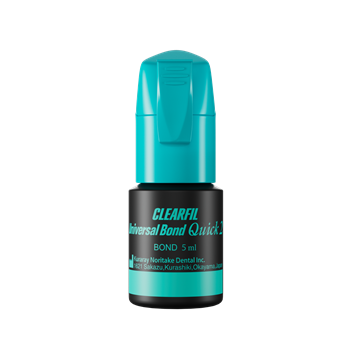
4. Kuraray Clearfil Universal Bond Quick 2
Best for: High-volume practices where chair time reduction is the top priority.
Clearfil Universal Bond Quick 2 is built around speed, with a rapid application protocol and clinically well-established MDP monomer technology for reliable adhesion to enamel and dentin.
It carries one of the higher price points in the group, and its promotional structure requires purchasing eligible direct restorative products to unlock discounts — meaning savings are conditional on broader purchasing commitments rather than straightforward volume pricing.
Tradeoff: Speed comes with reduced technique flexibility, and the conditional pricing structure adds complexity for practices that prefer straightforward purchasing.
Clinical verdict: A strong fit for high-volume, efficiency-oriented practices where chair time reduction has real operational value — less compelling for clinicians who prioritize technique control or transparent pricing.
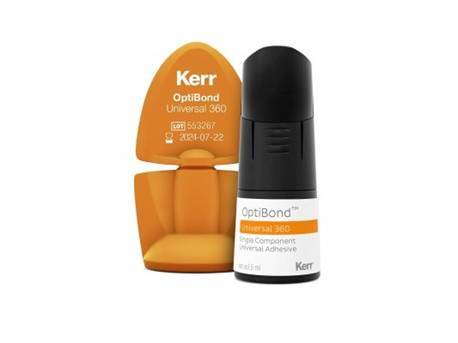
5. Kerr OptiBond Universal 360
Best for: Clinicians who value etching flexibility and are interested in emerging dark-cure capability.
OptiBond Universal 360 offers strong adhesion across a range of substrates and full etching flexibility, with its most distinctive feature being a Total Dark Cure Mode — making light curing optional when used with any resin cement.
With a water content of 5.38% and a price of $33.45/ml, the chemistry is solid.5 However, despite being marketed for glass ceramic use, internal testing has shown relatively low bond strength to non-etched e.max — a meaningful consideration for practices with significant indirect and ceramic volume.
Tradeoff: The Total Dark Cure Mode is a genuinely interesting differentiator, but it's newer technology still being optimized across the industry, and the glass ceramic bond strength data warrants close attention.
Clinical verdict: A solid, flexible option with forward-looking technology — but practices with heavy ceramic volume should review the glass ceramic bond strength data carefully before committing.
Which Dental Adhesive Is Right for You?
These five products are not interchangeable, and the decision comes down to what your practice actually does most.
If you run a high-volume mixed practice and need one adhesive for everything: All-Bond Universal. With the lowest water content in the group, strong dentin bond strength across all etch and cure modes, no activator required, and the lowest price per ml, it's the most clinically and financially versatile option in this comparison.
If brand familiarity and built-in silane for glass ceramic bonding are priorities: Scotchbond Universal Plus is the most established option in that category. Factor in the water content and per-ml cost, and weigh the silane stability research carefully for high-value ceramic cases.
If moisture control is your biggest chairside challenge: Prime & Bond Active's moisture tolerance is real and clinically relevant. Go in with clear awareness of the activator cost and what 19.5% water content means for long-term bond durability.
If chair time is your primary constraint: Clearfil Universal Bond Quick 2's speed protocol is a genuine advantage for high-volume practices. Weigh that against the cost structure and reduced technique flexibility.
If you do significant indirect work and want emerging dark-cure capability: OptiBond Universal 360 is worth evaluating with close attention to the glass ceramic bond strength data before relying on it for high-value indirect cases.
Choose a Dental Adhesive You Can Rely On
Every material decision in your practice accumulates over time. The dental bonding agent you reach for on every case, day in and day out, should be one that consistently delivers — not one you're troubleshooting, compensating for, or second-guessing when a case gets complicated.
By evaluating water content, bond strength data, activator requirements, and total system cost alongside price, you can make a more informed decision that serves both your workflow and your patients.
Ready to see what consistent, predictable bonding looks like in your practice? Explore All-Bond Universal at bisco.com or call our clinical team at 1-800-247-3368. Real people, real science, shipped directly to your practice.
Frequently Asked Questions
What is the best universal dental adhesive?
There's no single answer that applies to every practice. Which is exactly what this comparison is designed to help you work through. Evaluate water content, bond strength data across all etch and cure modes, activator requirements, and total system cost. Those four variables will tell you more than any marketing claim.
Do universal adhesives work on zirconia?
Yes, with proper surface treatment. Most manufacturers recommend a separate zirconia primer for optimal bond strength, regardless of what the adhesive label says about substrate compatibility. A dedicated primer paired with a proven adhesive will consistently outperform a single-bottle shortcut.
How do you reduce post-operative sensitivity when bonding?
Post-operative sensitivity can be reduced by keeping etched dentin moist so the adhesive can properly impregnate and seal the dentinal tubules during bonding. To keep dentin moist, excess water can be removed with high-volume suction or a cotton pellet instead of air drying. Many clinicians prefer a selective-etch technique, where only the enamel is etched with phosphoric acid while a universal adhesive is applied to dentin. This technique keeps the dentinal tubules sealed because the smear layer remains intact, while still providing strong enamel bonding and lowering the risk of post-operative sensitivity.
Does it matter if my adhesive contains silane?
More than most product literature suggests. Silane in a universal adhesive is intended to simplify glass ceramic bonding, but published research has demonstrated that silane becomes unstable in the low-pH environment of universal adhesives, leading to decreased bond strength over time.1,4 A separate ceramic primer remains the more reliable approach, and the clinical data supports it.
Is there a meaningful cost difference between these adhesives?
Yes, especially when you factor in activators. Products that require a separate activator for indirect procedures can add $40–50+/ml to the effective system cost. Always calculate the total cost of the system, not just the bottle price.
References
*Data on file. BISCO, Inc.
1. Yoshihara K, Nagaoka N, Sonoda A, Maruo Y, Makita Y, Okihara T, Irie M, Yoshida Y, Van Meerbeek B. Effectiveness and stability of silane coupling agent incorporated in 'universal' adhesives. Dent Mater. 2016 Oct;32(10):1218-1225.
2. Suh, Beyoung I. “Adhesive Systems.” Principles of Adhesion Dentistry: A Theoretical and Clinical Guide for Dentists, AEGIS Publications, LLC, Newtown, PA, 2013, pp. 110–115.
3. Kim YR, Kim JH, Son SA, Park JK. Effect of Silane-Containing Universal Adhesives on the Bonding Strength of Lithium Disilicate. Materials (Basel). 2021 Jul 16;14(14):3976
4. Yao C, Yu J, Wang Y, Tang C, Huang C. Acidic pH weakens the bonding effectiveness of silane contained in universal adhesives. Dent Mater. 2018 May;34(5):809-818.
5. Tested by a third party lab via the Karl Fischer Method